ServicesStair Flooring
Stair Flooring in Richmond
Stairs take more wear than any other floor in your home, and they are the hardest part to get right. We replace worn carpet, cover old treads with hardwood, vinyl plank or laminate, and explain each choice in plain terms so you know what you are paying for.
What stair flooring actually involves
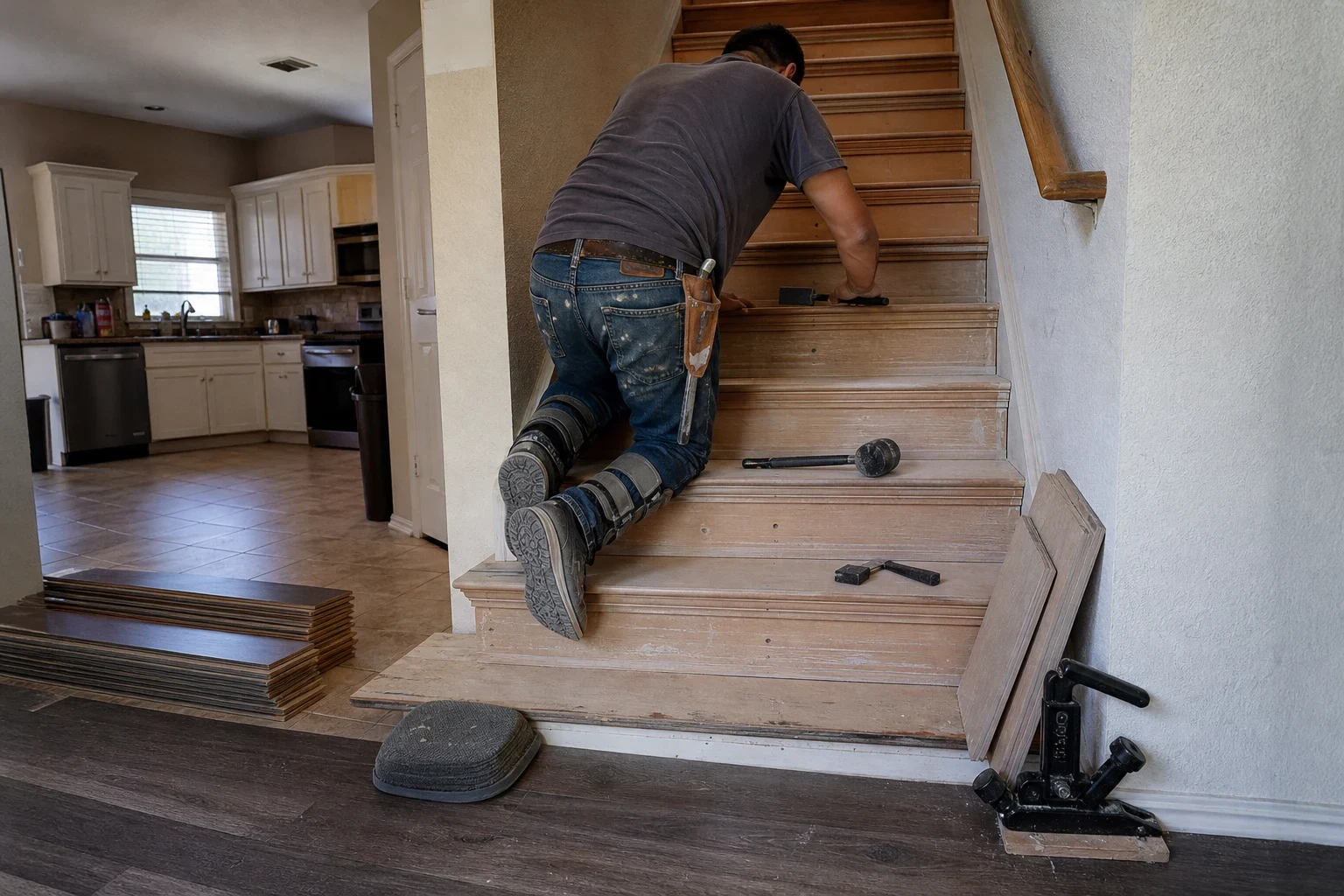
A staircase is not just a small floor. Each step has a tread you walk on, a riser that faces you, and a nosing, the rounded front edge where most slips and most wear happen. Every one of those pieces has to be cut, fitted and fastened on its own, and the nosing is where a cheap job shows first.
Many two-story homes around Richmond were built with carpet over plain particleboard or pine treads. That is fine under carpet, but it cannot be left bare. If you want a hard surface, the old treads either get capped with new ones or replaced outright. We look at your stairs first and tell you which one your staircase needs, and why.
We have been installing floors for over 25 years, and we are insured. Stairs are often the last piece of a bigger project, so we usually match them to the hardwood flooring, luxury vinyl plank or laminate flooring going in on the floors above and below.
What we handle on a stair project
- 01
Tearing out the old surface
We pull old carpet, pad and tack strip, or remove worn treads, and haul it away. Staples and nails come out so nothing pokes through the new material.
- 02
Firming up loose treads
A squeak usually means a tread has worked loose from the stringer below. We glue and screw it down before anything new goes on top, because new flooring over a loose step will squeak just as much.
- 03
Treads, risers and nosing
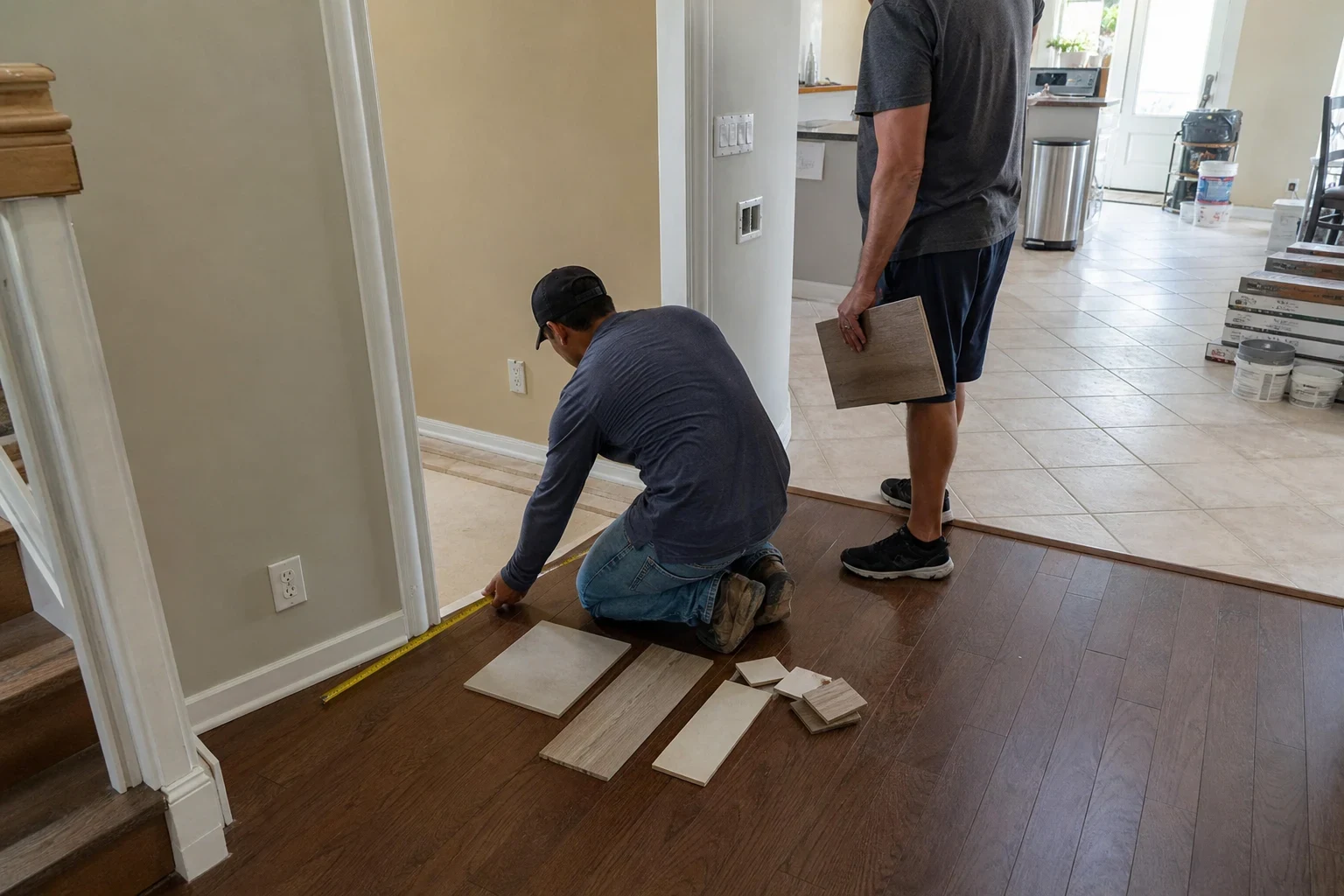
For hard surfaces we fit new treads and risers, plus a matching stair nose piece on vinyl plank or laminate. Each piece is measured to its own step, since older staircases are rarely perfectly square.
- 04
Carpet on stairs
We explain the two common styles. A waterfall install drapes carpet over the edge, and an upholstered install wraps it tightly under each nosing. Pad is cut to the tread so the edge stays crisp, and carpet installation for the rest of the floor can be done the same visit.
- 05
Trim and finishing details
Skirt boards, landing edges and the transition at the top and bottom step all get finished so the stairs blend into the floors around them.
Questions about Stair Flooring?
Call(346) 480-5524Signs your stairs are ready for new flooring
Carpet worn flat on the edges
The front edge of each step wears out years before the rest. Once you can see backing or pad at the nosing, the carpet no longer grips well underfoot.
Squeaks or a step that gives
Movement means fasteners have loosened. It is worth fixing now, and new flooring is the natural time to do it.
Mismatched floors
You put new vinyl plank or hardwood downstairs and the old carpeted stairs now look out of place between two finished floors.
Slippery or chipped edges
Worn finish or damaged nosing on hard stairs is a real trip risk, especially for kids, pets and older family members.
Allergies or stubborn stains
Stair carpet traps dust and pet hair in a spot that is hard to vacuum. Some families simply want a surface they can wipe clean.
How a stair job runs, step by step
- 1
Look and measure
We check each step, the stringers and the condition of the treads under the old surface. Then we walk you through your options and what each one means for cost, feel and upkeep.
- 2
Plan for even step heights
Adding material to the treads changes the height of the top and bottom steps. We plan the thickness so every step stays close to the same rise, because an uneven first or last step is what people trip on.
- 3
Tear-out and prep
Old material comes out, loose treads get secured, and the work area is protected. We keep one path clear when we can so your family can still get upstairs.
- 4
Install and clean up
Treads, risers, nosing or carpet go in from the top down or bottom up depending on the material. We clean up the dust and debris and show you the finished stairs before we leave.
What changes the price of stair flooring
Stairs are priced by the step, not by the square foot, because each one takes its own cutting and fitting. Here is what moves the number up or down. We spell out each item in your quote so nothing is hidden.
- Number and shape of steps
- A straight run is the simplest. Winder steps, pie-shaped turns and landings take far more cutting and time.
- What is under the old surface
- Solid treads in good shape can often be capped. Particleboard or damaged treads may need full replacement first.
- Open or closed sides
- An open side with balusters means more detailed returns on each tread, and sometimes balusters have to come out and go back in.
- Material choice
- Carpet usually runs lowest, vinyl plank and laminate fall in the middle, and solid hardwood treads cost the most. We explain what you gain with each.
Stair flooring questions we hear most
Can you put vinyl plank or laminate right over my carpeted stairs?
Not over the carpet itself. The carpet, pad and tack strip have to come off first. If the treads underneath are solid, we can usually cap them with new treads and stair nose pieces. If they are particleboard or damaged, we replace them.
Will my stairs match the floor I just had installed?
In most cases, yes. Most vinyl plank and laminate lines offer matching stair nose pieces, and hardwood treads can be stained to match your floors. If an exact match is not available, we show you the closest options before ordering.
Is hard flooring on stairs slippery?
It can be more slippery than carpet, especially in socks. A textured surface and a nosing with a slight profile help a lot. If slipping is a concern, we can talk about a carpet runner style or simply staying with carpet.
Can we still use the stairs during the job?
Usually, with care. We try to leave a clear path and let you know when a section needs to stay off-limits, such as while adhesive sets.
Is the work covered after you finish?
Yes. We stand behind our installations with a 1-year workmanship warranty, so if a tread loosens or a nose piece lifts because of how it was installed, we come back and fix it.
Ready to talk about your staircase?
Tell us how many steps you have and what is on them now. We will explain your options in plain terms and set up a time to measure.